Evaluating Trig Functions for Any Angle
The grand finale of Unit 3: combining everything — coterminal angles, reference angles, the ASTC rule, and the unit circle — into one unified strategy that works for any angle.
Introduction
This lesson ties together every skill from Unit 3. Given any angle — positive, negative, larger than , in degrees or radians — you will follow a systematic algorithm to find the exact trig value without a calculator.
Past Knowledge
Coterminal angles, reference angles, ASTC rule, and Q1 unit circle values.
Today's Goal
Execute a 4-step algorithm to evaluate any trig function at any angle exactly.
Future Success
This strategy is the foundation for solving trigonometric equations, proving identities, and graphing trig functions in Unit 4.
Key Concepts
The 4-Step Evaluation Algorithm
- Step 1: Normalize the angle. If the angle is negative or greater than (), find a coterminal angle between and .
- Step 2: Identify the quadrant. Determine which quadrant the normalized angle falls in.
- Step 3: Find the reference angle. Use the appropriate formula for that quadrant.
- Step 4: Apply the sign. Look up the Q1 value of the reference angle, then attach the correct sign using ASTC.
The Complete Unit Circle
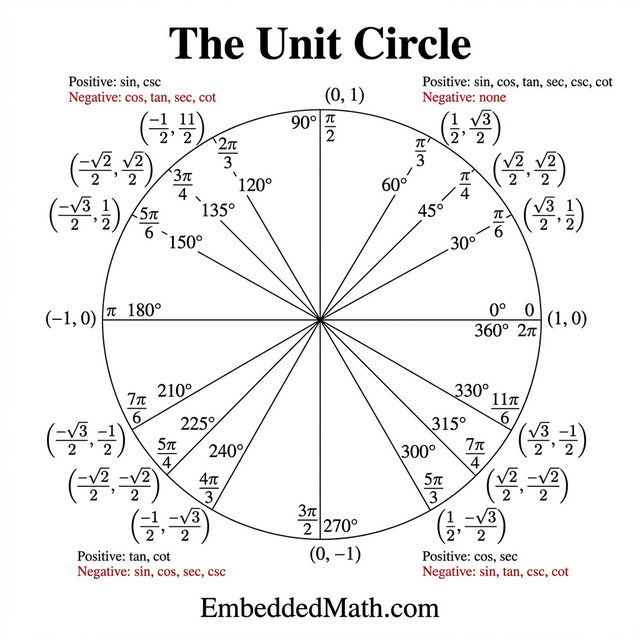
Here is the full unit circle showing all standard angles and their coordinates. This is the result of applying the algorithm systematically:
Worked Examples
Quadrant III Evaluation
Question: Evaluate .
Step 1: Normalize. is between and ✓
Step 2: Quadrant. → Quadrant III.
Step 3: Reference angle.
Step 4: Value + Sign. . In QIII, tangent is positive (ASTC: T).
Final Answer:
Negative Angle
Question: Evaluate .
Step 1: Normalize.
Step 2: Quadrant. → Quadrant III.
Step 3: Reference angle.
Step 4: Value + Sign. . In QIII, cosine is negative.
Final Answer:
Large Angle Beyond 2π
Question: Evaluate .
Step 1: Normalize.
Step 2: Quadrant. → Quadrant III.
Step 3: Reference angle.
Step 4: Value + Sign. . In QIII, sine is negative.
Final Answer:
Common Pitfalls
Skipping the Normalization Step
If the angle is negative or larger than , you must normalize first. Trying to find the reference angle of directly will give the wrong quadrant and potentially the wrong answer.
Applying the Wrong Sign
The reference angle always gives you the magnitude. The ASTC rule tells you the sign. Getting the reference angle right but the sign wrong means you missed the last step — arguably the most important one.
Real-Life Applications
Robotics and Inverse Kinematics
When a robot arm needs to reach a specific point in space, the control system works backwards from the target coordinates to determine the joint angles — a process called inverse kinematics. This requires evaluating trig functions at arbitrary angles (often negative or beyond ) to determine motor positions. The 4-step algorithm you just learned is exactly what these systems execute millions of times per second.
Practice Quiz
Loading...