Intro to the Unit Circle
The unit circle is a circle with radius centered at the origin. It is the single most important diagram in all of trigonometry — every trig value you will ever need lives somewhere on this circle.
Introduction
Up to now, trigonometric ratios (sine, cosine, tangent) were defined using a right triangle. This restricts us to acute angles between and . The unit circle extends these definitions to all angles — including negatives, angles greater than , and everything in between.
Past Knowledge
SOH CAH TOA defines sine, cosine, and tangent using a right triangle with angle .
Today's Goal
Understand that on the unit circle, and for any point on the circle.
Future Success
The unit circle is the backbone of graphing trig functions, proving identities, and solving trig equations.
Key Concepts
What is the Unit Circle?
The unit circle is a circle with:
- Center at the origin
- Radius
- Equation:
Connecting SOH CAH TOA to (x, y) Coordinates
Place a right triangle inside the unit circle. The hypotenuse is the radius (), the horizontal leg lies along the -axis (adjacent), and the vertical leg is parallel to the -axis (opposite). By SOH CAH TOA:
The Unit Circle Identity
Every point on the unit circle has coordinates:
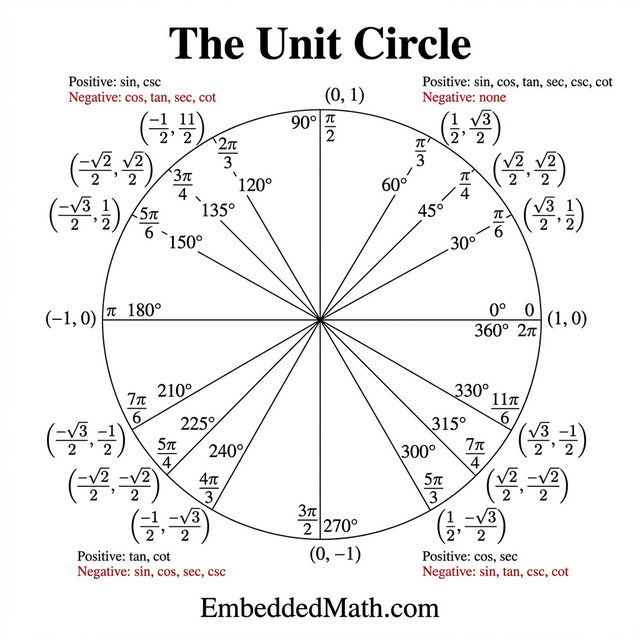
Visualizing the Unit Circle
The graph below shows the unit circle. Any point on it is at the coordinates where is the angle from the positive -axis.
The Pythagorean Identity
Since every point on the unit circle satisfies , and , :
This is the Pythagorean Identity — the most used identity in all of trigonometry.
Worked Examples
Reading Coordinates from a Point
Question: A point on the unit circle at angle has coordinates . Find and .
Step 1: Identify coordinates.
On the unit circle, the -coordinate is cosine and the -coordinate is sine.
Final Answer: ,
Using the Pythagorean Identity
Question: A point on the unit circle in Quadrant I has . Find .
Step 1: Apply the Pythagorean Identity.
Step 2: Solve.
Step 3: Choose the sign. In Quadrant I, both and are positive, so is positive.
Final Answer:
Verifying a Point is on the Unit Circle
Question: Is the point on the unit circle?
Step 1: Plug into .
Final Answer: Yes! The point satisfies , so it lies on the unit circle. It corresponds to the angle ().
Common Pitfalls
Swapping Sine and Cosine
is always the -coordinate (horizontal) and is always the -coordinate (vertical). Many students instinctively assign sine to because “S comes before C in the alphabet.” That mnemonic will betray you!
✅ Memory aid: “x is for cosine” — both start with sounds that are NOT “s.”
Ignoring the Sign of Coordinates
In Quadrants II, III, and IV, some coordinates are negative. The -coordinate is negative on the left side of the circle, and the -coordinate is negative below the -axis. This makes cosine or sine negative in those quadrants.
Real-Life Applications
Audio Signal Processing
Every sound wave is modeled as a sine or cosine function. When your phone receives a WiFi signal, the receiver chip traces a point on the unit circle at extremely high speed to decompose the incoming wave into its cosine (in-phase) and sine (quadrature) components — a technique called IQ demodulation.
Practice Quiz
Loading...