Hydrostatic Pressure and Force
In fluids, pressure increases with depth. To find the total force on a submerged vertical plate (like a dam or submarine window), we integrate the varying pressure across the surface.
Think of a vertical window on a submarine. The water pushes harder at the bottom of the window than at the top because pressure increases with depth.
To find the total force, we slice the surface into thin horizontal strips, calculate the force on each strip, and integrate to sum them all up.
Pressure and Force
The Key Relationship
Hydrostatic pressure at depth is:
Fluid density (for water, ≈ 1000 kg/m³)
Gravitational acceleration (≈ 9.8 m/s²)
Depth below the surface
Common value: For water, N/m³ (or 62.4 lb/ft³ in imperial units).
From Pressure to Force
Force = Pressure × Area. For a thin horizontal strip at depth with width and thickness :
The Formula
To find the total hydrostatic force on a submerged vertical plate:
Step-by-Step Process:
Worked Example
Rectangular Plate
A meter plate is submerged vertically with the top edge at the water surface. Find the total hydrostatic force. (Use N/m³)
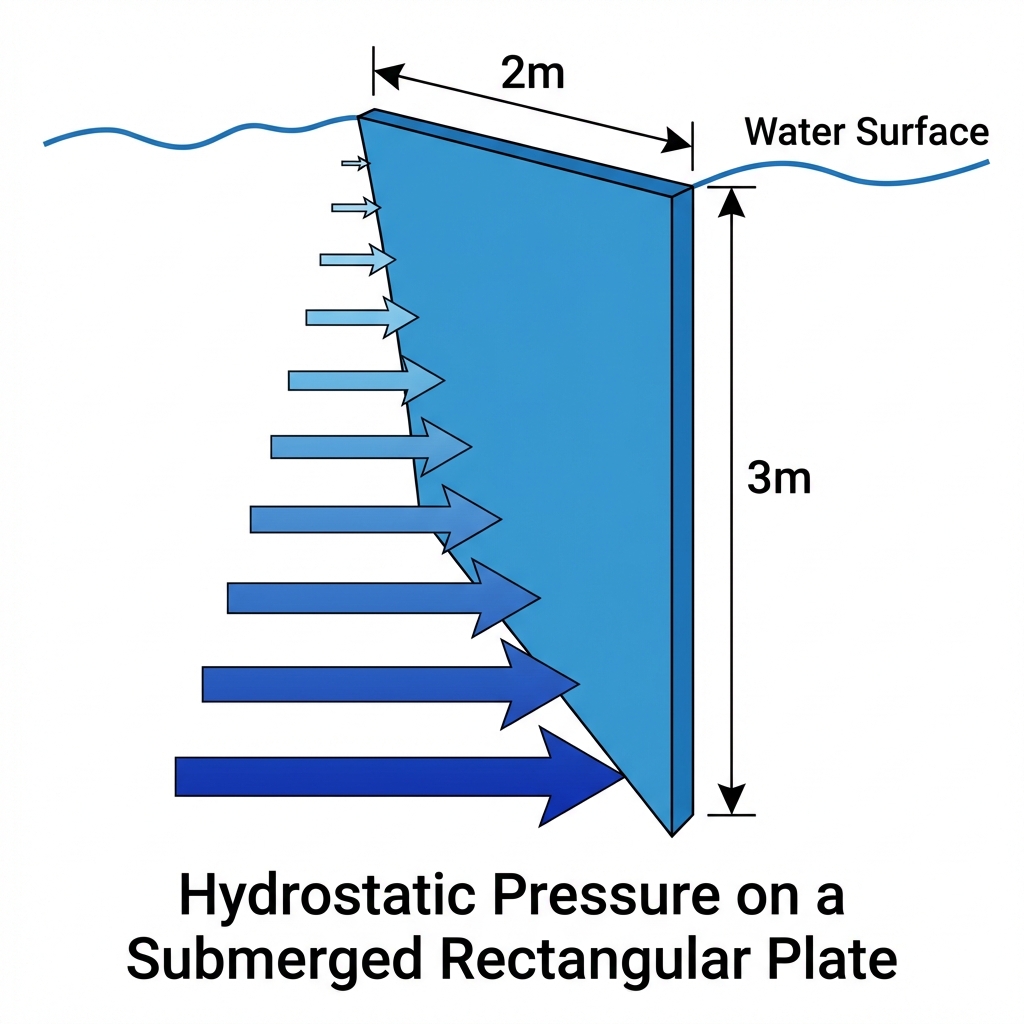
Let at the surface, positive downward. The plate extends from to .
At position : depth = , width = (constant for a rectangle).
That's about 88 kilonewtons — roughly the weight of 9 metric tons pushing against the plate!
Level Up Examples
Example 2: Triangular Gate
An inverted triangular gate (base width 4 m, height 2 m) is submerged with the top edge at the surface. Find the hydrostatic force.
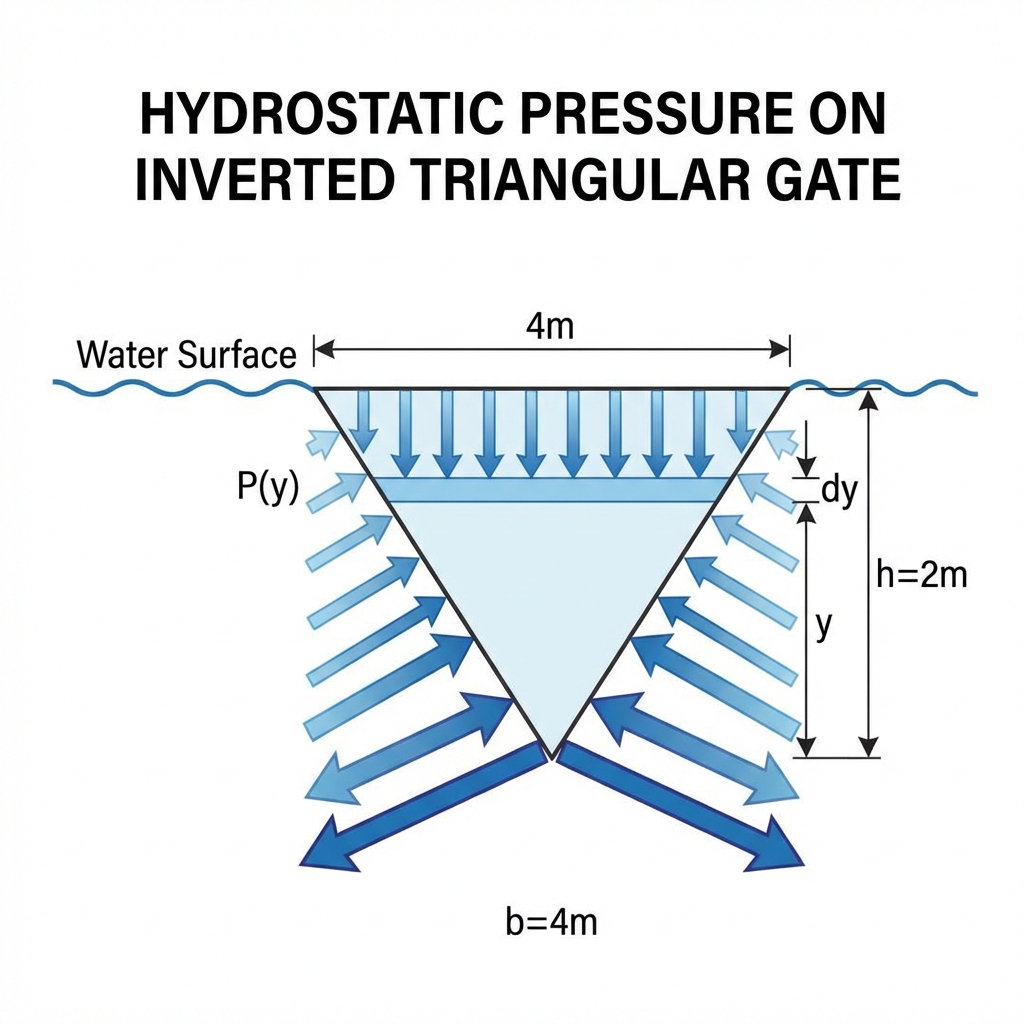
Key insight: The width changes with depth! We need to use similar triangles to find .
At the surface (), width = 4. At the bottom (), width = 0.
By similar triangles:
Example 3: Deep Submersion
A m square plate is submerged with its top edge 10 m below the surface. Find the hydrostatic force.
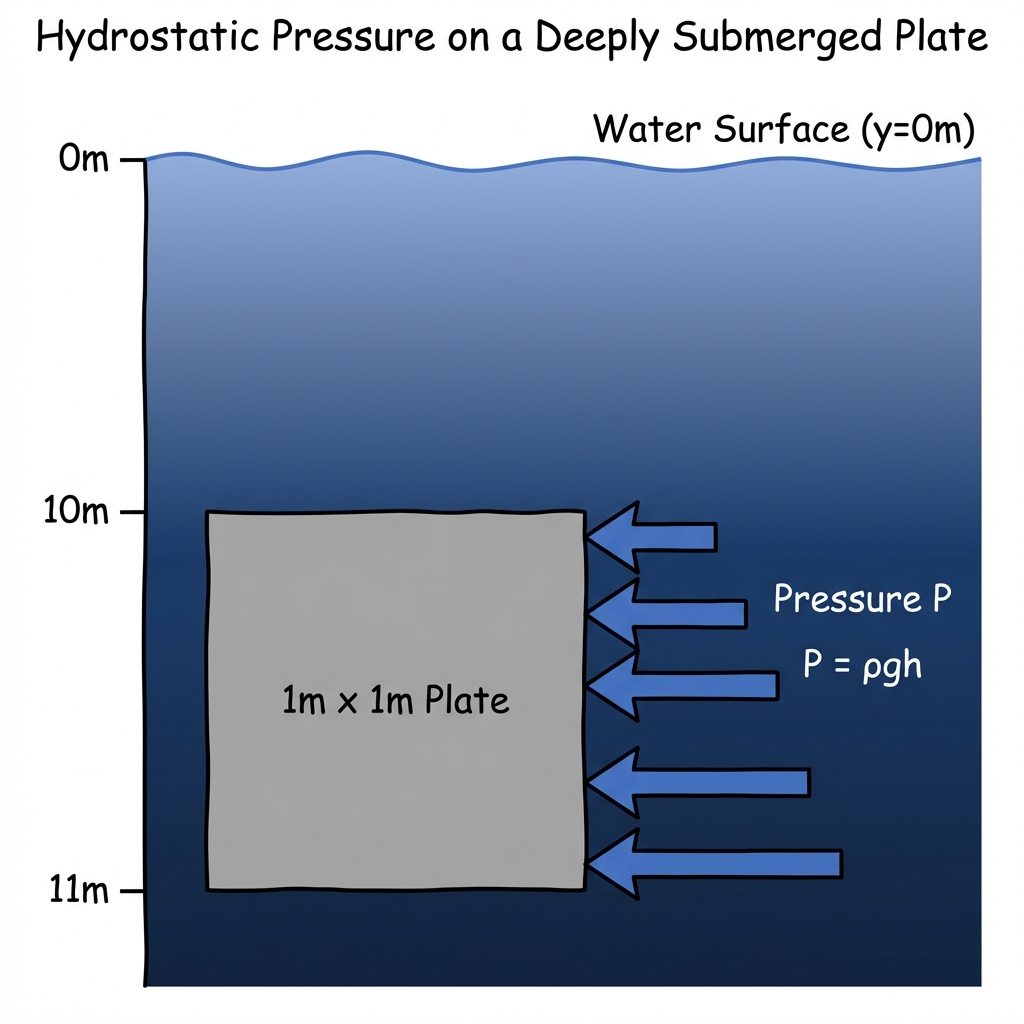
Key insight: The plate is NOT at the surface! Depth ranges from 10 to 11 meters.
The plate spans to . At position , depth = , width = .
Even though the plate is smaller (1×1 vs 2×3), the force is greater because it's so deep!
Practice Quiz
Practice Quiz
Loading...