Center of Mass
The Center of Mass (or Centroid) is the geometric balancing point of a thin plate. If you placed a pin at this exact point, the shape would balance perfectly!
Think of a thin flat plate (called a lamina) cut into an irregular shape. Where is the exact point where you could balance it on a needle?
We find this by calculating moments — the "rotational weight" around each axis — and dividing by the total area.
The Center of Mass
The Key Idea: Moments
A moment measures the "tendency to rotate" around an axis. It's calculated as:
For a continuous region, we integrate to sum up all the tiny moments.
Measures horizontal position. Each thin strip at position contributes times its area.
Measures vertical position. Each strip's center is at height .
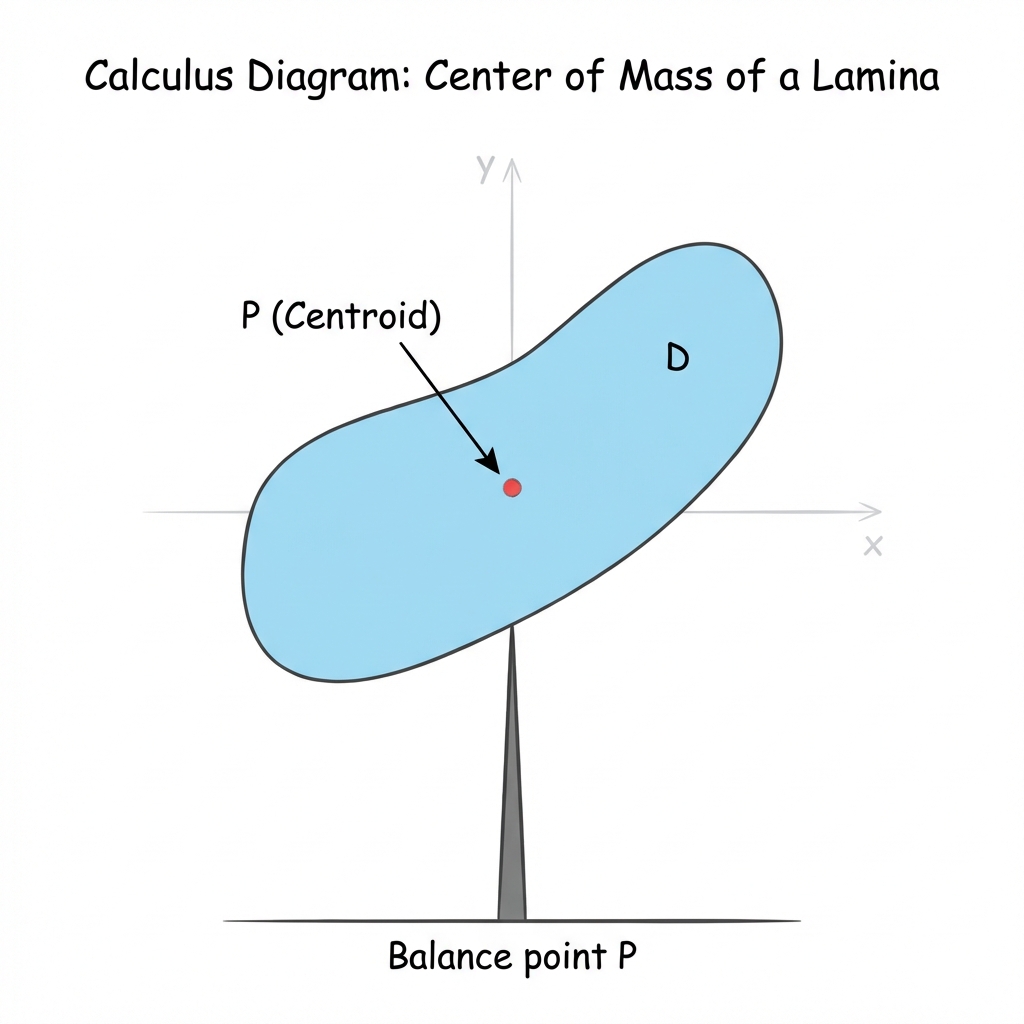
A lamina perfectly balanced at its centroid P — the shape won't tip in any direction!
Centroid Formulas
For a region under the curve from to :
x-coordinate of Centroid
Where is the total area.
y-coordinate of Centroid
The comes from the center height of each vertical strip.
Memory tip: uses "" (position × height). uses "" (average height of the strip).
Worked Example
Triangular Region
Find the centroid of the region bounded by , , and .
This is exactly ⅔ of the way along both the base and height — a property of all triangles!
Level Up Examples
Example 2: Parabolic Region
Find the centroid of the region under in the first quadrant.
Region goes from to (where the parabola hits the x-axis).
Example 3: Discrete Masses (1D)
Masses of 2 kg, 3 kg, and 5 kg are located at positions respectively. Find the center of mass.
For discrete masses: Instead of integrating, we sum!
Notice the center is pulled toward the heavier 5 kg mass at .
Practice Quiz
Practice Quiz
Loading...