Parametric Curves
Standard functions fail to describe loops or self-intersections. Parametric equations separate horizontal and vertical motion, controlling both with a "time" variable .
Variables Separated
As increases, the point traces a path.
Parametric Plotter
x(t) = cos(3t), y(t) = sin(2t)
Worked Example
Eliminating the Parameter
Convert to Cartesian form.
Table of Values
| Point | |||
|---|---|---|---|
| −1 | 1 + 2 = 3 | 0 | (3, 0) |
| 0 | 0 − 0 = 0 | 1 | (0, 1) |
| 1 | 1 − 2 = −1 | 2 | (−1, 2) |
| 2 | 4 − 4 = 0 | 3 | (0, 3) |
| 3 | 9 − 6 = 3 | 4 | (3, 4) |
The Graph
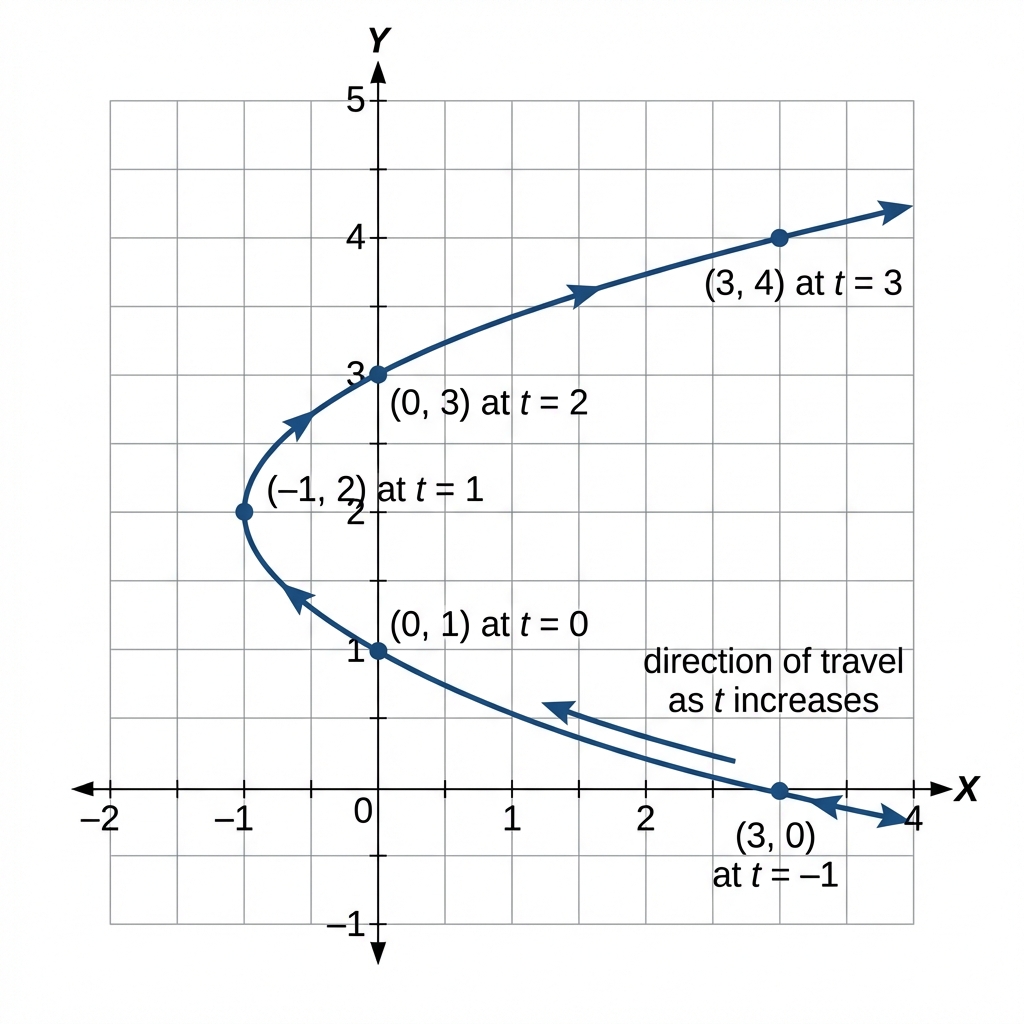
Notice how the points trace out a sideways parabola as increases.
This confirms the graph is a sideways parabola opening to the right!
Level Up Examples
Example 2: The Unit Circle
Table of Values
| Point | |||
|---|---|---|---|
| 0 | 1 | 0 | (1, 0) |
| 0 | 1 | (0, 1) | |
| −1 | 0 | (−1, 0) | |
| 0 | −1 | (0, −1) |
The Graph
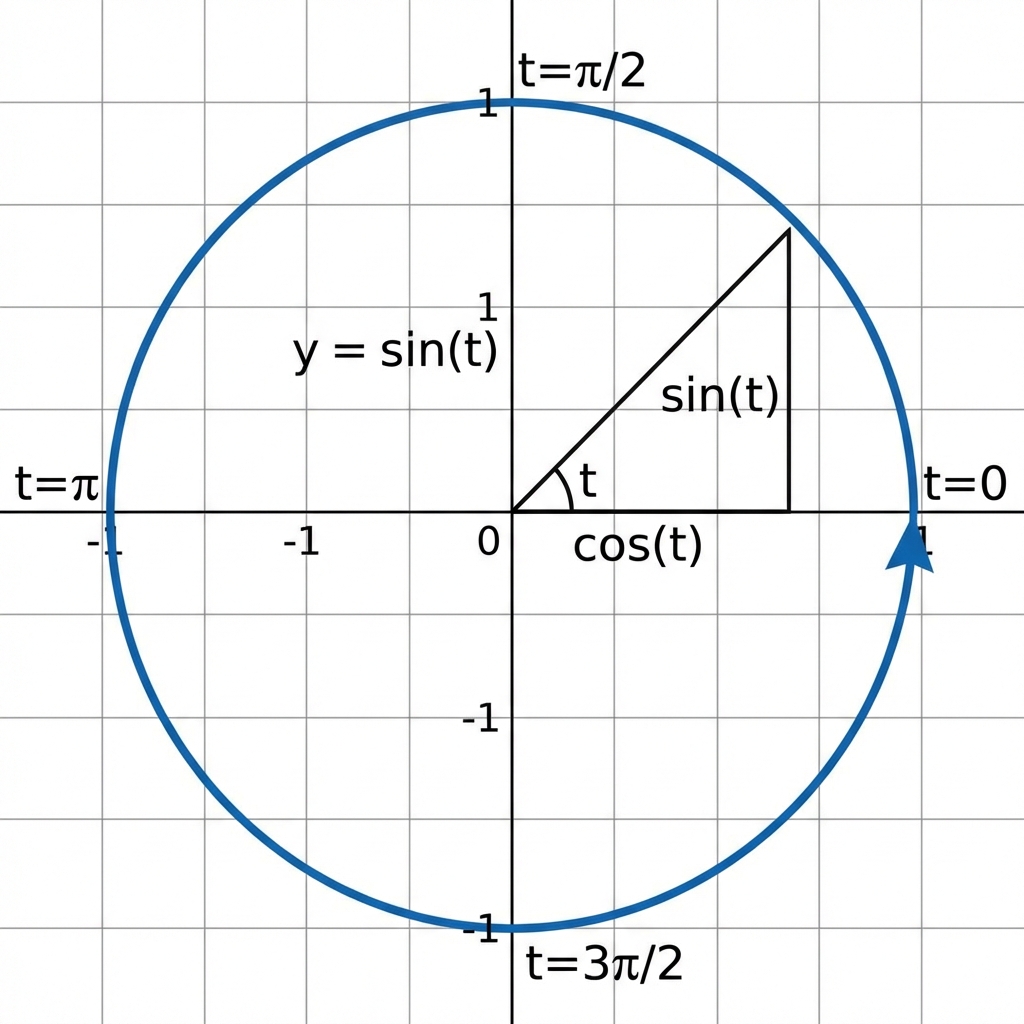
The Pythagorean identity gives us the unit circle!
Example 3: The Cycloid
The cycloid is the path traced by a point on a circle as the circle rolls along a straight line. It's the solution to the famous "brachistochrone" problem!
Cycloid Visualizer
x = t − sin(t), y = 1 − cos(t)
| 0 | 0 | 0 |
| 2 | ||
| 0 |
Fun fact: A ball rolling down a cycloid reaches the bottom faster than on any other curve — even faster than a straight line!
Example 4: Family of Curves
Investigate how changing a parameter affects the curve:
Use the slider below to explore how the parameter transforms the curve. Watch how the shape changes dramatically as varies!
Family of Curves Explorer
x = a + cos(t), y = a·tan(t) + sin(t)
Explore: Try a = 0, 1, and 2. What happens at a = -1? Families of curves help us understand how changing parameters creates different mathematical shapes.
Practice Quiz
Practice Quiz
Loading...