Calculus with Parametric Curves
How do you find the slope when isn't directly a function of ? We use the Chain Rule: The change in over time divided by the change in over time.
The Parametric Derivative
The Key Formula
(provided )
Why This Works
Since isn't directly a function of , we use the Chain Rule. The change in over time, divided by the change in over time, gives slope!
Think of It As
At any moment, slope = how fast you're moving up vs. how fast you're moving right
Second Derivative (Concavity)
Important: First find as a function of , then take its derivative with respect to , and divide by again.
Worked Example
Complete Analysis of a Parametric Curve
A curve C is defined by the parametric equations
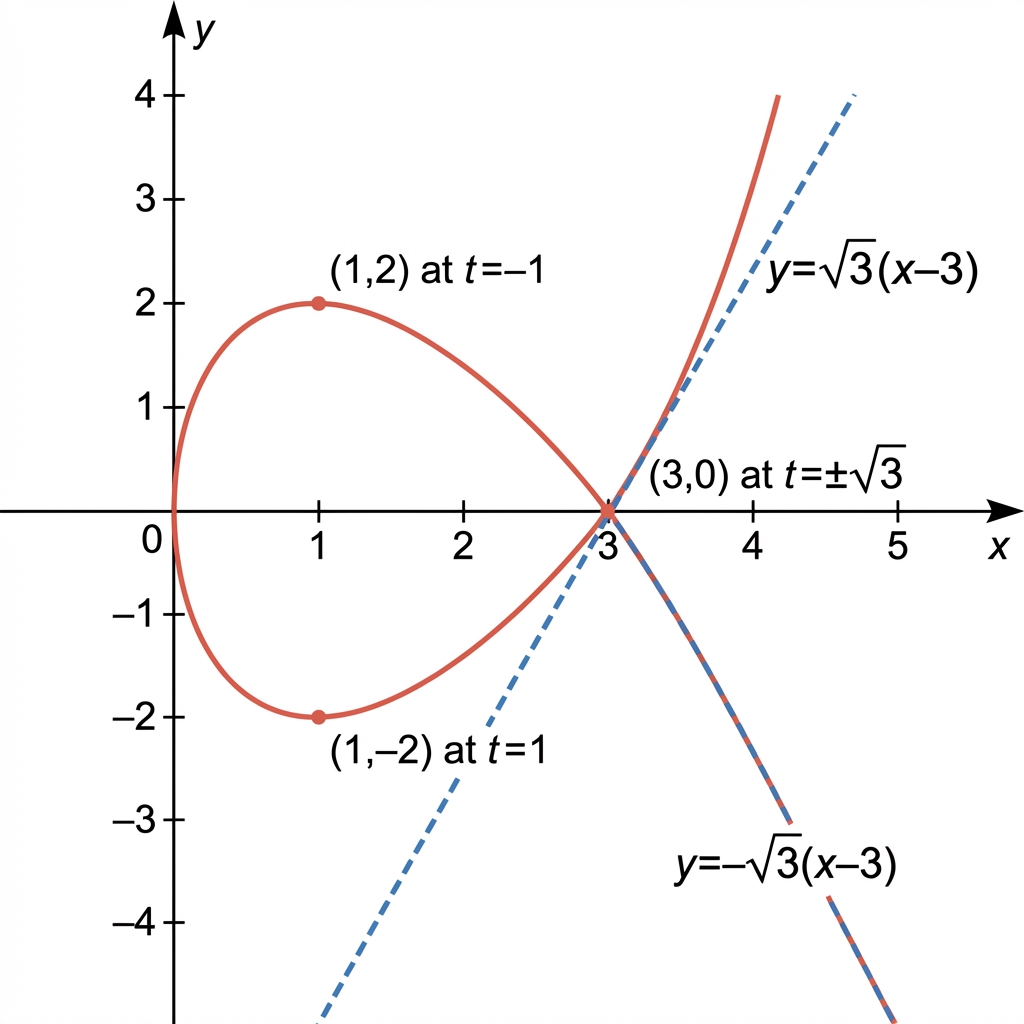
(a) Show that C has two tangents at (3, 0) and find their equations
Find t values: At (3, 0), we need and
From , we get or
Checking: ✓ and ✓
Find derivatives:
At :
At :
(b) Find where the tangent is horizontal or vertical
Horizontal tangent:
when
Points: (1, -2) at t = 1 and (1, 2) at t = -1
Vertical tangent:
when
Point: (0, 0) at t = 0
(c) Determine where the curve is concave upward or downward
Second derivative:
Using the quotient rule on :
So:
Concave upward: when (since numerator is always positive)
Concave downward: when
(d) Key features of the sketch
- Vertical tangent at origin (0, 0)
- Horizontal tangents at (1, 2) and (1, -2)
- Self-intersection at (3, 0) with two distinct tangent lines
- Concave down for t < 0 (upper loop), concave up for t > 0 (lower loop)
Level Up Examples
Cycloid Tangent Lines
The cycloid is defined by
(a) Find the tangent to the cycloid at the point where θ = π/3
Find the point:
Find derivatives:
At :
(b) At what points is the tangent horizontal? When is it vertical?
Horizontal tangent:
for integer n
At : point is
(top of each arch)
Vertical tangent:
for integer n
At : cusps at
(where the curve touches the ground)
💡 Key Insight
At the cusps (θ = 0, 2π, ...), both and , so the formula is indeterminate. Using L'Hôpital's Rule or the limit as , we find the tangent approaches vertical.
Practice Quiz
Practice Quiz
Loading...